
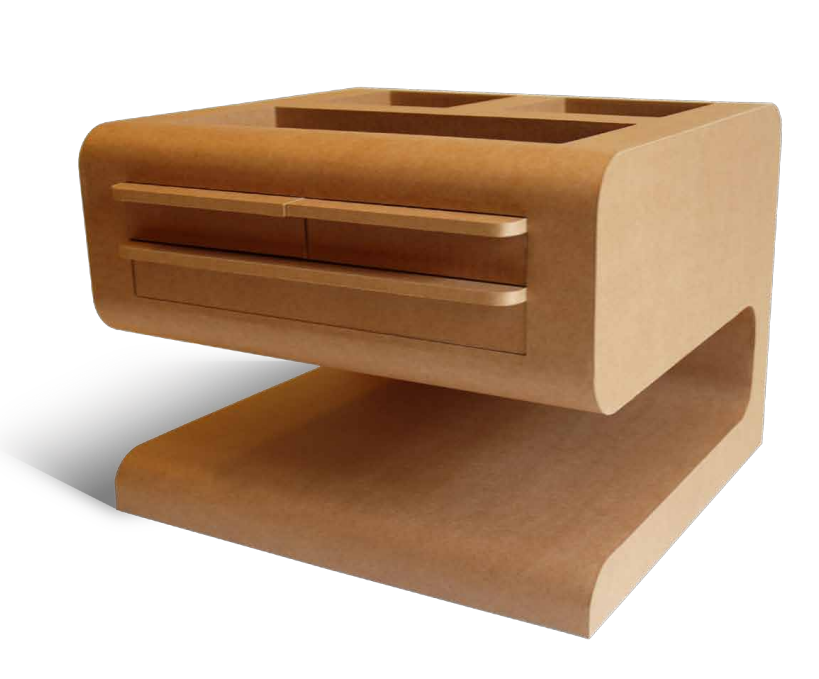
The design, as presented to us by the author in his objects cut and assembled from cardboard, is extremely interesting. First of all, the use of a material that is very rarely used for this purpose is surprising.
Here we are faced with a question to which most designers answer similarly, namely that the value of the product should result through its rich material design. Such a product seems unattainable and technically too difficult to manufacture.
When using cardboard, the everydayness of the material also suggests so-called homemade solutions. This puts the designer in a completely different position towards the user of his products, as it allows him to participate in an otherwise closed circle. The designer, however, remains unattainable due to his mastery in technical production itself, as only his precision can bring out the key details of an individual product.
Every cut, every edge and gluing system is the author’s unique work and a unique invention, and we can observe it as a supreme artistic act.
One can feel the dedication to the material and the author’s coexistence with it. Here all questions regarding the aesthetic orientation of the product fall away, as it is clear that the author is more interested in ethics in design and less in aesthetics.
However, this question is addressed by key experts in aesthetic disciplines. Therefore, I once again conclude that it is more pleasant to observe products with a personal touch than industrial, cold and already seen things. The products of designer Primož Antloga can be classified as unique or industrial design. In his further work, he will have to show clearer outlines of his interests and adapt them to the market or to himself.
Boris Zaplatil, academic painter